Medinah No. 3 changes moved from preview material to retrospective analysis after the 2026 Presidents Cup window passed. The event was scheduled for September 22-27, 2026, and the official course overview listed the championship setup as a par 72 measuring 7,564 yards at Medinah Country Club Presidents Cup course overview. Because the research notes do not include match results, player records, weather, or scoring data, this assessment focuses on the confirmed architectural and routing changes that shaped the venue’s match-play questions.
How Medinah No. 3 Changed For Match Play
The major pre-event question was not whether Medinah would be recognizable by name. It was how the renovated version would ask elite players to make decisions. OCM, the Australian design firm associated with Geoff Ogilvy, Mike Cocking, and Ashley Mead, oversaw a 2023-24 renovation, and PGA TOUR reporting described major scale changes: fairway acreage doubled from about 29 acres to 58 acres, average green size increased from roughly 6,000 square feet to about 8,600 square feet, bunker count rose from 70 to 117, total sand area reached about 204,000 square feet, and rough was reduced to about 48 acres, roughly one-third of its prior extent PGA TOUR preview.
Those numbers point to a course that did not simply become easier or harder. Wider fairways can make tee shots look more inviting, yet larger target areas often shift the contest toward angle control. A player who finds the short grass but chooses the wrong side can still face a guarded line into a larger, more contoured green. The reduction in rough also matters. Less rough can create more recovery possibilities, but it can also expose players to fescue, sand, uneven stances, and approach angles that are more punishing than a uniform collar of thick grass.
Medinah No. 3 By The Numbers
Medinah No. 3 played at 7,564 yards in the listed Presidents Cup setup, but yardage alone gives an incomplete picture. The fairway expansion was the clearest structural signal. Doubling short-grass acreage likely encouraged more aggressive driving lines, especially in a team format where one partner’s position can influence how the other player weighs risk. In foursomes, the calculus changes because a missed angle can burden a teammate with the next shot. In four-ball, a safer ball in play can free the second player to challenge a preferred line.
The larger greens also deserve careful treatment. Bigger greens do not automatically mean simpler approach shots. They can create more hole locations, wider separation between safe zones and scoring zones, and longer first putts after conservative approaches. In match play, a shot to 35 feet may be acceptable if an opponent is in trouble, but it may feel passive if the opponent has a wedge from the correct angle. That tension is exactly where renovated championship architecture can show its value.
Width, Bunkers, And Reduced Rough
The bunker increase from 70 to 117 was one of the most visible design shifts in the research. More bunkers can define preferred sides of fairways, frame carries, and create clearer penalties for shots that miss by shape rather than distance. With total sand area reported at about 204,000 square feet, players likely had to account for both fairway bunkers and green-side recovery demands.
Reduced rough also changes how spectators read a hole. A wide corridor may look forgiving from outside the ropes, but the best professionals are rarely judging only whether a ball is findable. They are judging spin, stance, angle, and the next shot’s height requirement. That is why a course with broader fairways can still ask harder strategic questions than a narrower layout.
Routing Choices And Late-Hole Pressure
The tournament routing was one of the clearest competitive adjustments. Matches were set to begin on what members play as the fifth hole, then use the members’ first through fourth holes as the closing stretch. That choice was designed to make more of the club’s dramatic holes available late in matches. In team match play, this type of routing matters because many contests do not reach the 18th hole. Moving selected holes toward the finish can affect which decisions are seen under the most pressure.
From a design-analysis standpoint, altered routing is not merely an operations choice. It changes rhythm. A hole that functions as an early-round settling point for members can become a late-match decision point for professionals. Tee-shot comfort, layup options, and hole-location tolerance all feel different when a match is tied, one down, or dormie. The research does not provide hole-by-hole scoring from the event, so any claim about which side benefited would go beyond the record supplied here.
Why The Finish Was Recast
Finishing stretches at match-play events are valuable because they compress architecture, pressure, and crowd energy into fewer shots. The reroute placed members’ Nos. 1-4 late in the match order. That likely helped organizers avoid a common match-play problem: strong holes sitting unused after matches end early. It also allowed the event to place more consequential choices closer to the result of each contest.
There is a cautious distinction to make. A better-positioned finishing hole is not automatically a better golf hole. Its value depends on whether the design offers credible alternatives. If the correct play is obvious, the hole may still produce drama through execution, but it does less strategically. Based on the research, the most defensible point is that the routing change gave the tournament a better chance to show selected holes at decision time.
Team Formats And Architectural Incentives
The Presidents Cup format changes the way a course is tested. In singles, a player’s risk tolerance is mostly personal and match-state driven. In four-ball, one player can attack after a partner has secured position. In foursomes, both players carry the consequence of a poor angle or recovery shot. A wider, more angular course can expose those differences more clearly than a narrow corridor course that repeatedly asks the same question.
For readers exploring how different sports analyze strategic spaces, NBA Playbook provides insights into court-spacing analysis and parallels with golf’s architectural factors and strategic variables.
What The Renovation Changed Strategically
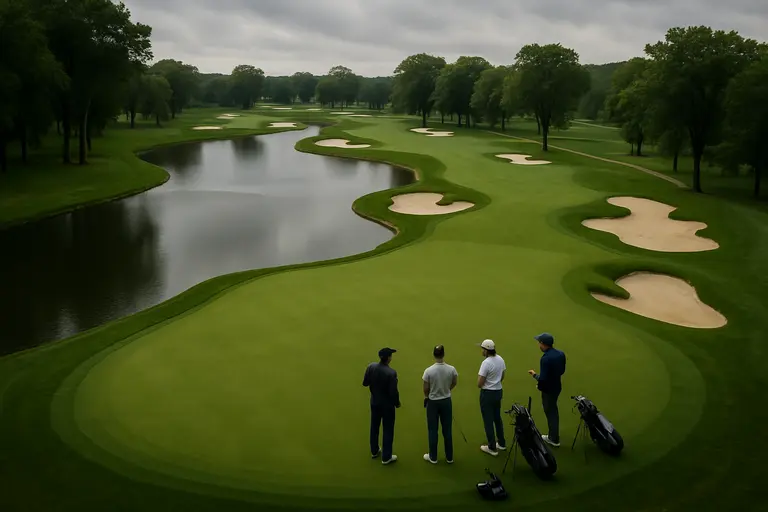
The central renovation theme was choice. The course’s wider fairways invited players to select lines instead of only trying to survive the tee shot. The larger greens created more approach targets but likely made proximity and putting distance more dependent on angle. The added bunkers clarified penalties and shaped sightlines. The reduced rough shifted some penalty away from thick grass and toward position-specific hazards and recovery demands.
That blend fits modern championship architecture more than simple defense. Rather than relying only on narrowness, it asks whether a player can identify the correct side of a fairway, accept the right miss, and match club selection to the match situation. A conservative shot can be strong if it leaves the opponent to make the first mistake. An aggressive shot can be sound if the reward is a realistic winning birdie chance. The renovation’s numbers support the view that Medinah was set up to test those judgments.
An internal design review of the Medinah No. 3 renovation strategy gives related context on how wider corridors and Lake Kadijah angles were expected to affect match-play choices. The key caution remains the same: without confirmed post-event shot data in the supplied research, the best analysis is architectural rather than statistical.
- Fairway expansion likely emphasized angles rather than simple accuracy.
- Larger greens likely widened the gap between safe approaches and scoring approaches.
- More bunkers gave players clearer visual and strategic penalties.
- Reduced rough changed recovery play, but did not remove risk.
- The rerouted finish increased the chance that stronger holes appeared late in matches.
Medinah No. 3 Presidents Cup Takeaways
Medinah No. 3 entered the 2026 Presidents Cup with a changed architectural identity: broader fairways, larger greens, more bunkers, less rough, and a tournament routing intended to place key holes later in matches. Those confirmed changes support a cautious but clear reading. The course was positioned less as a narrow driving exam and more as an angle-based match-play venue.
The most meaningful effect was likely not one single feature. It was the interaction among width, sand, green scale, and routing. A player could have more space from the tee and still face a demanding second shot. A team could choose safety and still leave an opponent with the better angle. A match could reach the closing stretch and encounter holes placed there specifically because the tournament wanted them to matter.
That is the fair design lesson from the supported record. The renovation gave Medinah a different strategic vocabulary for the Presidents Cup. Any stronger claim about scoring outcomes, player preferences, or decisive holes would require verified event data not included in the research supplied here.