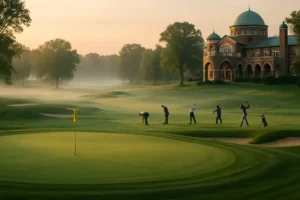
The starting point for Baycurrent Classic strategy is not simply length, even on a par-71 setup listed at about 7,322 yards. From October 8-11, 2026, Yokohama Country Club hosts a no-cut, 72-hole PGA Tour stroke-play event in the FedExCup Fall, with 500 FedExCup points to the winner. The routing uses a composite course: 16 holes from the West Course and two from the East, at a club originally designed by Takeo Aiyama in 1960 and remodeled by Bill Coore and Ben Crenshaw in 2015, according to the PGA Tour facts sheet.
That profile points toward a course where the best decisions may be made before the ball is struck. A no-cut format can encourage aggressive scoring, but Yokohama’s tree-lined corridors and positional demands still ask players to choose angles, not just yardages. The evidence from the 2025 event suggests low scoring is available: Xander Schauffele won at 19 under par, and Matt McCarty posted a course single-round record of 60 in the final round. Those numbers do not make the course easy in a broad sense; they show that players who control the right parts of the property can separate quickly.
Baycurrent Classic Strategy Starts With Routing
Composite Course Demands
The composite routing matters because it prevents a simple read of Yokohama Country Club as one uninterrupted West Course examination. With 16 West Course holes and two East Course holes in play, competitors must prepare for a tournament setup rather than only a member routing. That often shifts the emphasis toward repeatable pre-shot mapping: where the fairway is widest, which side gives a fuller green view, and where a miss leaves a playable recovery.
Coore and Crenshaw remodels are often associated with width, ground options, and visible strategic choices, but any claim about intent should be made with caution unless the architects have stated it directly. What can be said from the event data is narrower and more useful: Yokohama rewarded players who paired scoring bursts with enough control to avoid the hardest holes. For players building a plan, that means treating the round as a sequence of scoring windows and containment zones.
Why Position Beats Pure Force
For Baycurrent Classic strategy, tee shots should be judged by the second shot they create. The research set indicates that fairways can be wide in places, but tree-lined corridors and strategic bunkering make fairway position important. In practical design terms, width without the correct angle can be a half-trap: a drive may find short grass and still leave an awkward approach over a bunker edge or toward a shallow target.
That distinction is central at Yokohama. A player chasing only distance may gain a shorter club but lose access to the proper section of the green. A player who gives up a few yards to hold the preferred side can control spin, trajectory, and landing angle. In a 72-hole no-cut event, that trade can be rational even for aggressive scorers because the course offers enough birdie chances without forcing every tee ball to maximum output.
Scoring Holes And Damage Control
The Par-5 Scoring Windows
The clearest scoring signals come from the par 5s. PropGolf’s preview, based on 21,554 shots from the 2025 tournament, identified the par-5 sixth as the easiest hole, averaging 0.67 strokes under par with about 66% birdie or better, while the par-5 fourth averaged about 0.54 under par with about 60% birdie or better, according to the PropGolf course preview. Those are not marginal opportunities; they are holes where failing to take advantage can feel like losing ground to the field.
The best approach on those holes is likely controlled aggression. The first task is placing the tee shot where a second shot can be advanced without bringing the worst miss into play. The second task is judging whether the green is genuinely reachable or whether a wedge number offers a higher expected return. Because a no-cut field keeps playing through Sunday, players cannot rely on survival alone. They need birdies on the clear chances while avoiding the compounding error of turning an easy hole into a recovery exercise.
The Hardest Holes Shape The Card
The same PropGolf data marked the par-4 14th as the hardest hole at 0.30 strokes over par, with bogey or worse around 30%. The par-3 16th followed at 0.20 over par, with a bogey rate around 24% to 25%. Those two holes change how the closing stretch should be read. A player who arrives at the 14th after failing to score on the fourth and sixth may feel pressure to force a result, but the data argues for patience.
On a difficult par 4, the smartest play can be a conservative target from the tee followed by an approach that avoids short-sided misses. On a demanding par 3, center-green discipline is rarely glamorous, but it can preserve a round. This is where course architecture and tournament psychology meet: a hole does not need water on every side to create pressure. It only needs to make the recovery shot uncertain enough that the player starts aiming away from the trouble too late.
Approach Play And Green-Side Questions
Iron Control Into Bentgrass Greens
The research notes identify bentgrass greens at Yokohama, and that surface places a premium on distance control. The most useful iron players are not only those who strike the ball crisply; they are the players who manage carry yardage, spin, and landing section. On a course where the low score is available, proximity has direct value because makeable birdie putts become the separator once many players find greens in regulation.
For comparison across FedExCup Fall venues, the same principle appeared in a different form in Copeland Hills’ review of the Biltmore Championship course and field: venue fit is often less about one spectacular shot and more about whether a player’s standard pattern matches the course’s repeated questions. Yokohama asks those questions through approach angle, green access, and the ability to keep stress off the short game.
Recovery Shots Cannot Be An Afterthought
Even with low scoring in 2025, the green surrounds still matter. The player who misses on the correct side may save par with a routine pitch; the player who misses above the hole or behind a bunker can turn a neutral approach into a dropped shot. This is one reason the best Baycurrent Classic strategy should include planned misses. Aiming at every flag is not the same as playing boldly. In many cases, the bolder tournament decision is accepting a 25-foot birdie putt rather than risking a short-sided chip.
Putting on bentgrass also becomes more significant over four rounds. The available research supports the idea that strong approach play and fairway control are central, but putting still determines whether good ball-striking becomes 66 or 70. That is especially true after the field has learned the green speeds and hole locations. By the weekend rounds on October 10 and October 11, players who keep approaches under the hole may have a cleaner scoring path than those relying on repeated eight-foot par saves.
Field Context And FedExCup Fall Pressure

No-Cut Format Changes Risk
The no-cut structure should not be misread as permission to play recklessly. It reduces the immediate fear of leaving on Friday, but it also means all four rounds count toward a final leaderboard where a hot final round can move a player many places. In this format, early mistakes are not fatal, yet repeated bogeys on the difficult holes can remove the benefit of the par-5 scoring chances.
The PGA Tour field notes list returning champion Xander Schauffele among the players in Yokohama, with Wyndham Clark, Collin Morikawa, Hideki Matsuyama, Rickie Fowler, Min Woo Lee, and Ryo Hisatsune also included. That mix raises the standard for ball-striking and shot selection. It also gives the Japanese venue a strong local-interest element through Matsuyama and Hisatsune, while Schauffele’s 2025 win supplies a recent performance benchmark.
Cross-Sport Venue Reading
Golf is unusually transparent about how venue design shapes scoring, but the same habit of reading fields, walls, surfaces, and sightlines has value across sports. Those interested in how playing fields are an integral part of sports stories might enjoy visiting a related site in the same network, BooksonBaseball, which offers insights into the nuances of baseball fields.
Baycurrent Classic Strategy At Yokohama Country Club
A Practical Player Blueprint
A sound plan for Yokohama begins with three priorities: hold the correct fairway side, attack the par 5s with discipline, and treat the 14th and 16th as scorecard-protection holes. That blueprint does not guarantee contention, but it matches the evidence from the 2025 scoring profile and the stated 2026 setup. The best Baycurrent Classic strategy is likely to reward players who see the course in zones rather than as 18 isolated holes.
- Opening plan: establish fairway position before chasing hole locations.
- Scoring plan: use the fourth and sixth as primary birdie opportunities.
- Risk plan: avoid compounding errors on the 14th and 16th.
- Weekend plan: let iron proximity and controlled putting chances build pressure.
The caution is that one year of shot data, even a large sample, does not fully predict a tournament. Hole locations, wind, firmness, and player form can alter scoring patterns. Still, the available evidence points in a consistent direction. Yokohama Country Club appears set to reward disciplined aggression: enough ambition to make birdies where the design allows them, enough restraint to accept par where the course has historically pushed back.